
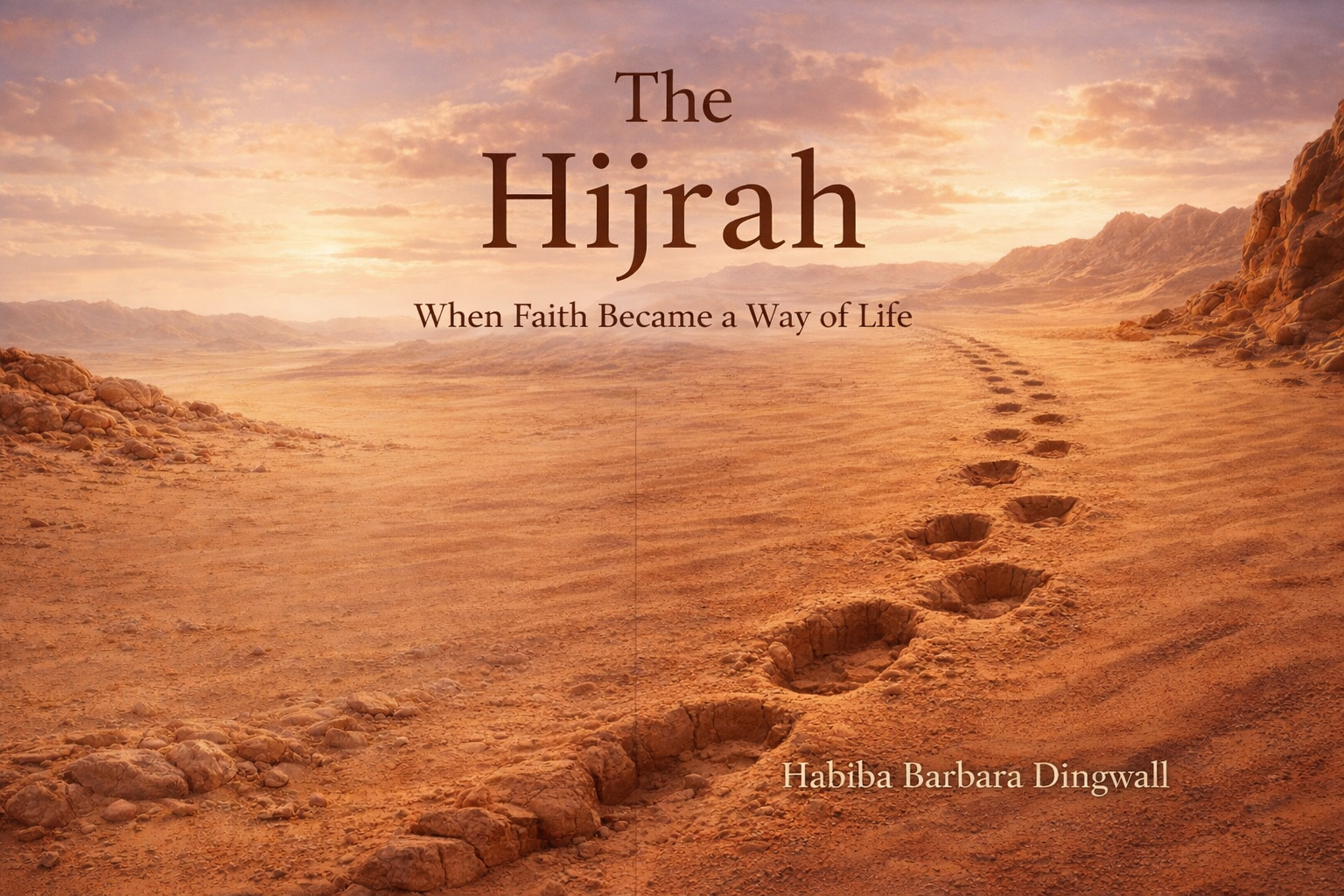
People usually see a book when it is finished. They see the cover, read the description, and perhaps watch a short announcement video. What they do not see is everything that has happened before that moment.
As I prepare to publish The Hijrah: The Journey That Changed History on 14 August, I have been thinking about how much of the launch process remains invisible. Writing the book was only the beginning. Bringing it into the world has involved editing, design, formatting, technical work, promotion, correspondence, planning, and a great many small decisions.
This is my first book launch, and I have been learning every stage as I go.
From Research to a Finished Manuscript
The book itself grew out of many years of reading, study, and reflection on the earliest period of Islamic history.
The Hijrah: The Journey That Changed History follows the story from the first revelations received by Prophet Muhammad ﷺ in Makkah, through the years of persecution and preparation, to the migration to Madinah and the Battle of Badr.
My aim was to bring these events together in a clear and engaging narrative. I wanted the book to be accessible to Muslims who wish to understand this history more deeply, to newer Muslims who may still be finding their way through unfamiliar names and events, and to non-Muslim readers who are interested in how Islam began.
Once the manuscript was complete, there were many rounds of revision. Dates, names, routes, events, sources, and historical details all had to be checked. Sentences that seemed clear to me sometimes needed to be rewritten so that they would also be clear to a reader encountering the story for the first time.
The final book is more than 220 pages, including appendices and sources by chapter.
Reconstructing the Route of the Hijrah
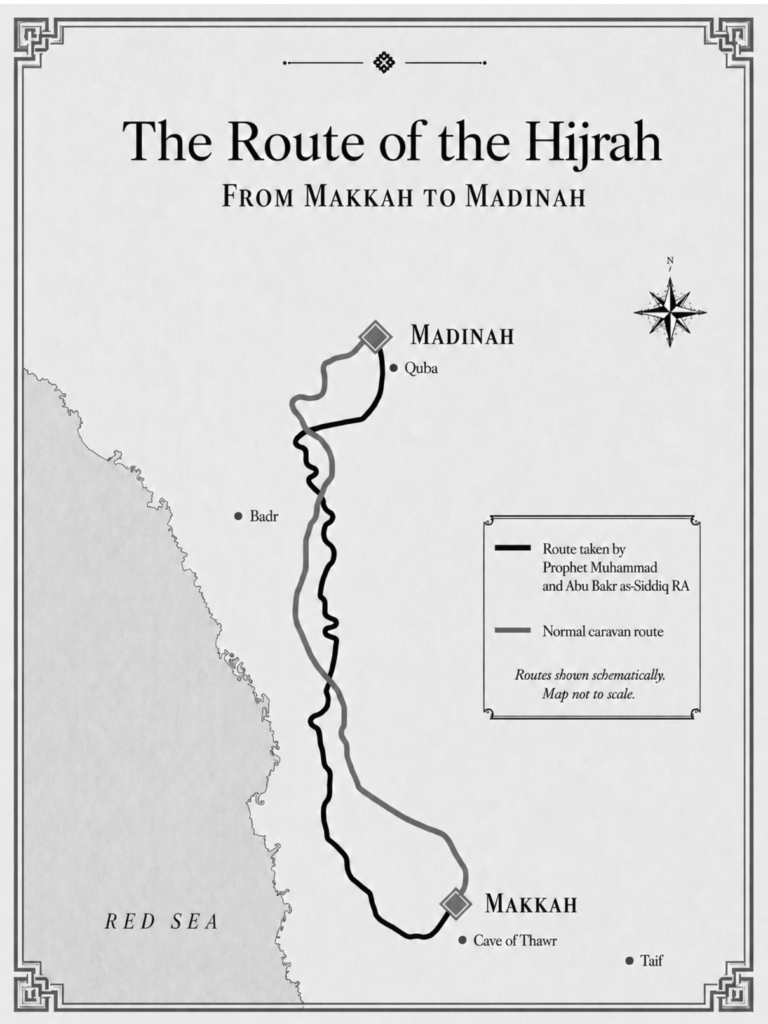
One unexpectedly difficult part of preparing the book was finding a suitable map of the route taken during the Hijrah.
Maps of the familiar caravan routes between Makkah and Madinah are relatively easy to find. The route followed by Prophet Muhammad ﷺ and Abu Bakr RA, however, was deliberately different. They first travelled south to the Cave of Thawr and then followed a less direct route towards the west and north, avoiding the usual road as they made their way to Quba and Madinah.
Although written descriptions of the journey exist, I could not find a single clear map that showed the route in the way I needed for the book. I compared several sources, studied the geographical descriptions, and eventually created the map myself.
It is not intended to be an exact, to-scale reconstruction. Rather, it is a representative map designed to help readers understand the general direction of the journey, its departure from the customary caravan routes, and the careful planning involved. Creating it was another reminder that even a seemingly small element in a finished book may require a considerable amount of research and problem-solving behind the scenes.
Editing and Proofreading
Editing a book is not one single stage.
There is the larger work of deciding whether the chapters are in the right order and whether the story moves clearly from one event to the next. Then there is sentence-level editing, where awkward or repetitive passages are refined. After that comes proofreading for spelling, punctuation, formatting, names, page numbers, headings, and countless other details.
Even after a manuscript feels finished, small problems continue to appear.
A word may be spelled differently in two places. A heading may sit too low on the page. A paragraph may break awkwardly between pages. A reference may need to be checked again. One correction can sometimes create another formatting problem somewhere else.
This part of the process requires patience, because the work is important but often almost invisible.
Designing the Cover
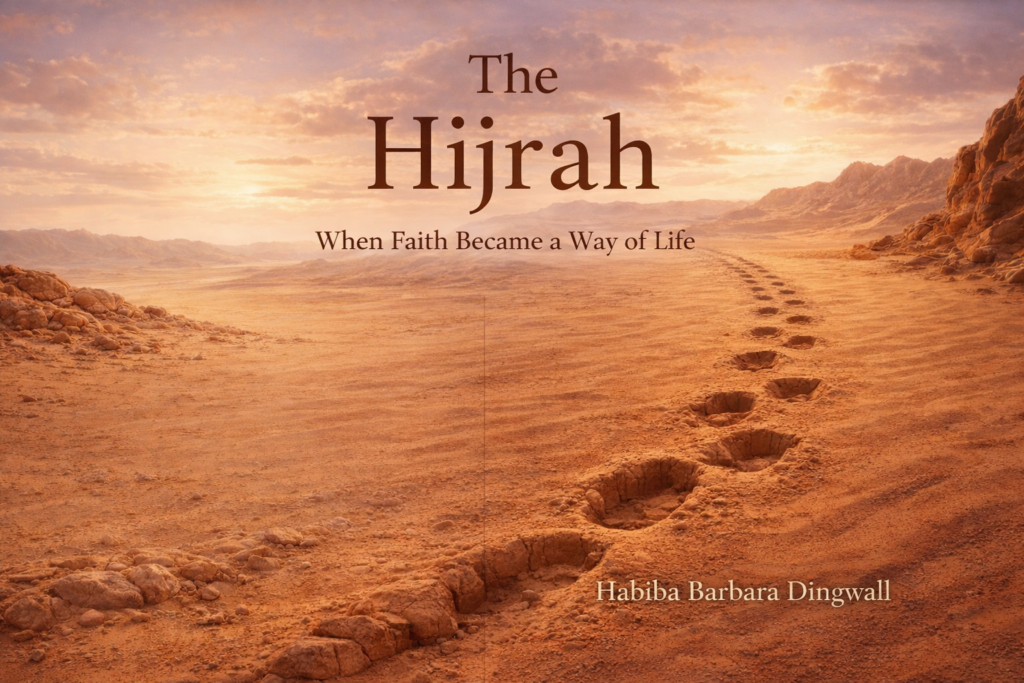
The cover went through many stages.
I wanted it to suggest the landscape of the Hijrah without becoming too literal or including details that would not be historically appropriate. The colours, lettering, placement of the title, back-cover text, spine, and overall balance all had to work together.
Small changes made a surprising difference.
A title that was slightly too large affected the spine. A landscape detail could make the image feel too modern. The position of the light, rocks, sky, or lettering could change the mood of the entire cover.
It took repeated adjustments to arrive at a design that felt right for the book.
Formatting the Print and Ebook Editions
A print book and an ebook are not simply the same file in two different forms.
The print edition needs carefully designed pages, margins, headers, page numbers, chapter openings, blank pages, and a layout that works when the book is physically held open.
The ebook needs a more flexible format so that readers can change the font size and read on different devices. This means that some elements have to be prepared differently.
Then the files must be uploaded, checked, corrected, and checked again.
A book may look perfect on a computer screen and still reveal problems when viewed in an online preview or printed as a physical proof.
Building the Website
The launch has also required building and refining my author website.
That has included creating pages for the books, writing descriptions, arranging menus, adding images, setting up the blog, and thinking about how visitors will move from one page to another.
I have had to consider questions such as:
What should readers see first?
How much information belongs on the main book page?
Where should the blog appear in the menu?
How can visitors easily learn about becoming an advance reader?
How should the companion books be introduced?
These are not things I thought much about while writing the manuscript, but they become very important once a book is ready to meet its readers.
Finding Advance Readers and Reviewers
Another important part of the launch has been reaching out to advance readers, reviewers, book clubs, and people who may be interested in sharing the book.
This involves writing emails, preparing review copies, explaining what the book is about, and contacting people whose audiences may genuinely appreciate it.
It can feel uncomfortable to promote one’s own work, particularly after spending so long quietly writing it. Yet readers cannot find a book if they do not know that it exists.
Advance readers are especially valuable because they can offer early responses and, when they wish, leave honest reviews after publication.
Learning Social Media
I have also been preparing posts and videos for Instagram, TikTok, YouTube, and UpScrolled.
This has meant learning about video sizes, captions, hashtags, carousels, teleprompters, thumbnails, titles, and posting schedules.
None of this is the same as writing a book.
A book allows space to explain an idea carefully. Social media often asks you to express that same idea in a few seconds or a few lines.
I am still learning how to speak on camera and how to share the story of the book without making every post feel like an advertisement.
One reason I want to share more behind-the-scenes material is that the process itself may be more interesting than simply repeating that a book is coming.
One Book Became a Collection
The main book led to The Hijrah Reflection Journal, a guided companion for readers who want to reflect on the meaning of migration, change, trust, sacrifice, and their own journey towards Allah.
Then came The Hijrah Activity Book, created for children ages 8 to 12. It combines short, accessible texts with puzzles, activities, maps, matching exercises, and reflection prompts.
Each book requires its own writing, editing, design, formatting, cover, description, website page, and promotional material.
What began as the launch of one book has gradually become the development of a small Hijrah collection.
The Decisions Readers Never See
Much of the work has consisted of decisions that most readers will never notice.
Should a historical term be explained in the text or placed in a glossary?
Should a chapter begin on the right-hand page?
Is a sentence simple enough for a new reader without becoming too simplistic?
Does an illustration look historically appropriate?
Is the print size comfortable?
Is a puzzle too easy, too difficult, or too repetitive?
Should the website description be detailed or brief?
Which image should appear in a blog post?
Where should a button lead?
There are hundreds of these small decisions behind a finished book.
The Emotional Side of Publishing
There is also an emotional side to the process.
For a long time, the book existed privately. It was something I researched, wrote, revised, and lived with on my own.
Publishing means allowing other people to read it, interpret it, respond to it, and perhaps criticize it.
That requires a different kind of courage from the courage needed to write.
There is excitement, certainly, but also uncertainty. Will readers understand what I was trying to do? Will the book reach the people who may benefit from it? Have I explained the story faithfully and clearly? Have I missed something that should have been included?
At a certain point, however, a book has to be released. One must make the best effort possible, trust Allah with the outcome, and allow the work to begin its own journey.
Publication Day Approaches
The Hijrah: The Journey That Changed History is scheduled to be published on 14 August, to correspond with the beginning of Rabi al-Awwal, the month in which Prophet Muhammad ﷺ was born.
There is still work to be done before then.
I am continuing with final checks, website updates, outreach, videos, blog posts, and preparation for the companion books.
I hope to share more of this process here, including some of the practical lessons I have learned about writing, formatting, cover design, publishing, and promoting a first book.
What Would You Like to See?
I would love to know which parts of the process interest you most.
Would you like to see more about:
- the research and writing of the book
- editing and proofreading
- the development of the cover
- formatting and publishing
- preparing the website
- contacting advance readers and reviewers
- creating the reflection journal
- creating the children’s activity book
- learning to make promotional videos
- the mistakes, revisions, and unexpected problems along the way
Please leave a comment below and tell me what you would most like to see behind the scenes.
If you have published a book yourself, I would also be interested to hear what part of the process surprised you most.
The finished book may be what finally reaches the reader, but the journey towards publication has been a story of its own.