
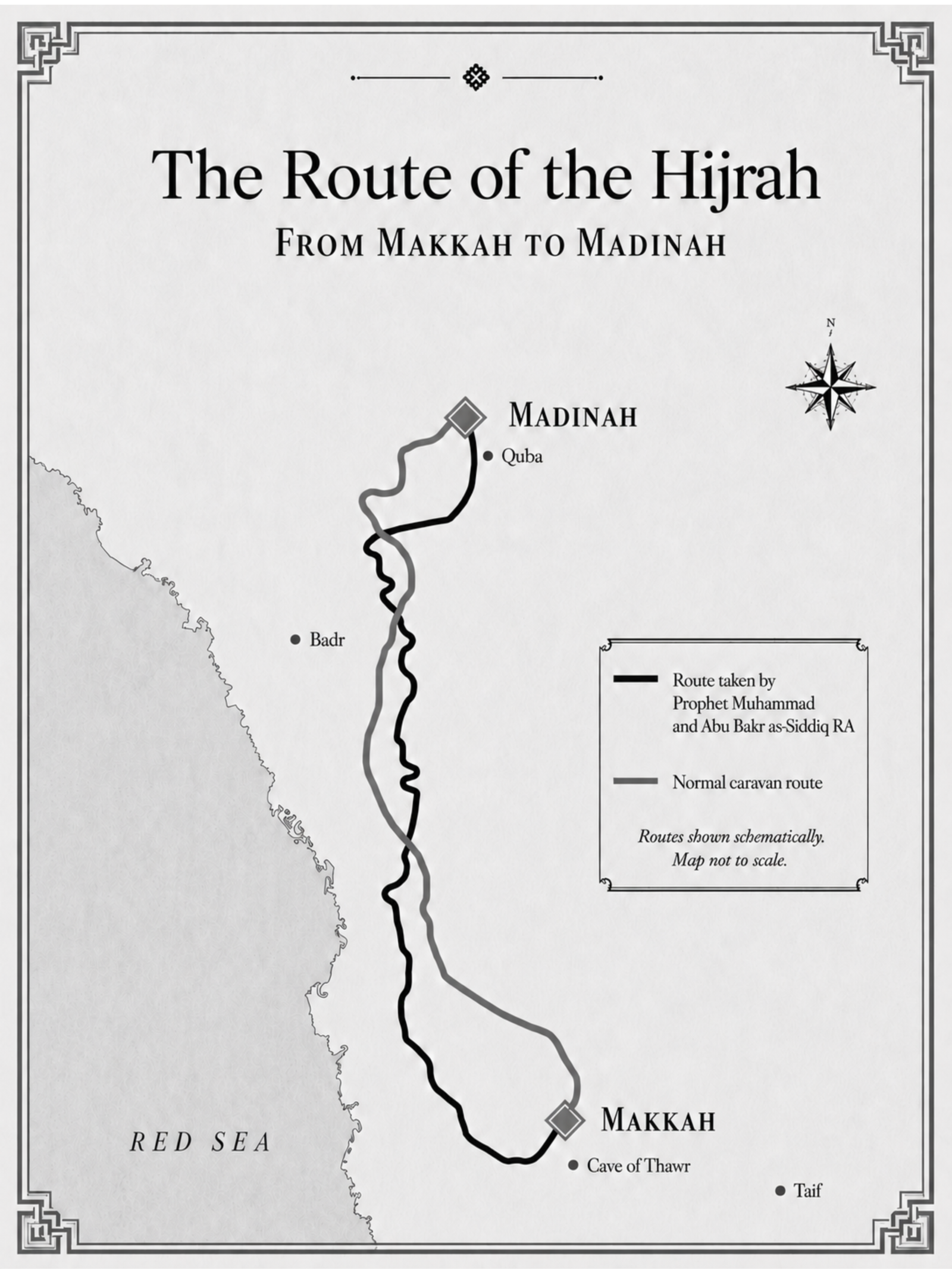
For a long time, these books existed only on my computer.
They were drafts, notes, rewritten chapters, half-finished ideas, images waiting to be adjusted, sources waiting to be checked, and pages that I kept telling myself were almost finished.
And then, somehow, they became books.
This week, alhamdulillah, I finally published my Hijrah series on Amazon.
It is difficult to describe what that feels like.
A Book That Kept Growing
The project began with The Hijrah: The Journey That Changed History.
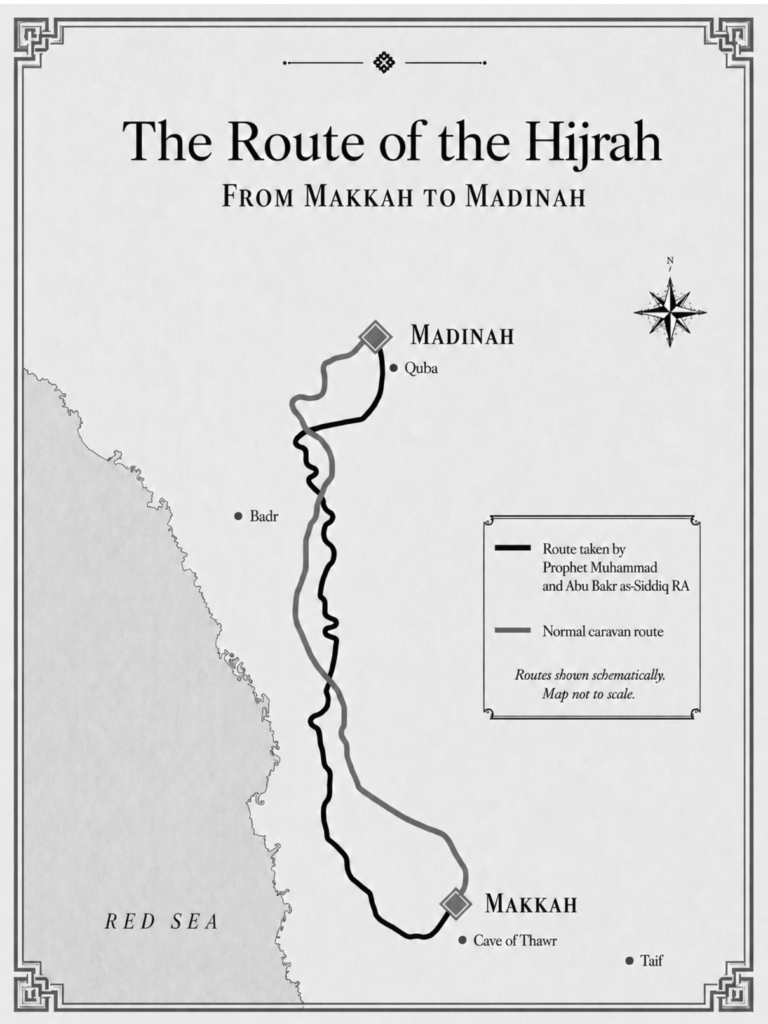
I wanted to tell the story of the Hijrah in a way that showed why it mattered. Not simply as the story of Prophet Muhammad ﷺ leaving Makkah and arriving in Madinah, but as part of a much larger story.
The Hijrah did not begin at the Cave of Thawr.
To understand it, we need to understand what came before: the first Revelation, the early Muslims, the persecution in Makkah, the migration to Abyssinia, the loss of Abu Talib and Khadijah (radiyallahu anha), Ta’if, the people of Yathrib who began accepting Islam, and the pledges at Aqabah.
And we also need to see what came afterwards.
The migration changed the Muslim community. A persecuted group became a community with a home, responsibilities, relationships, agreements, and new challenges. That is why the main book continues through the Battle of Badr and its immediate aftermath.
I thought I knew the story well when I began.
Writing it showed me how much more there was to learn.
Again and again I found myself stopping to ask: Where exactly did this happen? Who belonged to which clan? Why was tribal protection so important? What did this event mean to the people living through it? Would a reader who knows very little about early Islamic history understand what is happening here?
Those questions changed the book. They also made it much better.
Then One Book Became Three
Somewhere along the way, I realized that simply telling the story was not quite enough.
The Hijrah is also a story about leaving and moving toward.
It is about trusting Allah while still planning carefully.
It is about knowing when an environment is no longer helping us become who we are meant to be.
It is about friendship, sacrifice, patience, preparation, uncertainty, courage, responsibility, and beginning again.
That led to The Hijrah Reflection Journal.
The journal takes the lessons of the Hijrah and turns them inward.
What might I need to leave behind? What am I trying to move toward? Whose voices am I listening to? Who helps me stand firm?
What can I do when I do not yet see the whole road ahead? What does it really mean to make an effort and then trust Allah with the outcome?
This one became a very different kind of book, and in some ways a much more personal one.
And then came a third.
The Hijrah Activity Book grew from the idea that younger readers should be able to enter this story too.
It is designed for ages 9 and up, with short sections explaining the events of the Hijrah alongside activities, puzzles, reflection questions, a maze, a word search, and other ways to engage with the story.
I wanted it to be enjoyable, but I did not want to reduce the Hijrah to a few names and dates.
Children are capable of understanding much more than we sometimes give them credit for.
They can understand courage, fear, and loyalty.
They can understand that trusting Allah does not mean doing nothing.
And they can understand that good decisions often require both faith and careful planning.
The Part Nobody Sees
Publishing a book involves a remarkable number of things that have very little to do with writing a book.
There were maps. There were appendices. There were footnotes and source lists. There were covers. There was page formatting that refused to behave.
There were images that needed to be adjusted, resized, converted to grayscale, checked again, and sometimes recreated completely.
There were margins, trim sizes, barcodes, spine widths, QR codes, tables of contents, print previews, and files that looked perfect until they were uploaded somewhere else.
There were sentences that I rewrote far too many times.
There were moments when I thought I was finished, followed almost immediately by the discovery of something else that needed fixing.
And because I apparently enjoy making life complicated, while I was trying to finish one book, I created two more.
By the end, I was tired. Very tired.
But I also knew that I did not want to rush the final stages simply because I wanted to be finished.
If I had spent so long carrying these books toward publication, I wanted to give them the best final form I could.
Why I Wanted to Publish Them
The Hijrah is one of the defining events in Islamic history, but familiarity can sometimes make us move over it too quickly.
We know that the Prophet ﷺ migrated from Makkah to Madinah.
We know about the cave. We know about Abu Bakr (radiyallahu anhu). We know that Madinah welcomed the Muslims.
But when we slow the story down, it becomes much richer.
We see years of preparation. We see relationships being built before the migration ever begins.
We see people quietly carrying information, food, messages, and responsibilities.
We see the importance of trustworthy help. We see careful decisions made under enormous pressure.
And we see that tawakkul, reliance upon Allah, was never passive.
The Prophet ﷺ trusted Allah completely while taking every reasonable means available to him.
That lesson alone feels enormously important today.
And Now The Books Are There
There is something strange about seeing a book that lived inside your head suddenly appearing on an Amazon page.
You can click on it.
Someone you have never met can order it.
It can arrive in a house in another country.
Someone may sit down with it one evening, turn the first page, and begin a journey that you spent months, and in some ways years, trying to put into words.
That part is still sinking in.
The books are no longer mine in quite the same way.
Now they belong to their readers.
My hope is that The Hijrah: The Journey That Changed History helps people understand this extraordinary period more deeply.
I hope The Hijrah Reflection Journal helps readers think about their own lives with greater clarity and intention.
And I hope The Hijrah Activity Book helps younger readers discover that Islamic history is not distant or dry, but filled with real people, difficult choices, courage, wisdom, and lessons that still matter.
Most of all, I hope that something in these pages brings someone a little closer to Allah and a little closer to understanding the life of His Messenger ﷺ.
If that happens, then all those late nights, rewritten paragraphs, troublesome page numbers, and endless final corrections will have been worth it.
Alhamdulillah.
They are finally published.